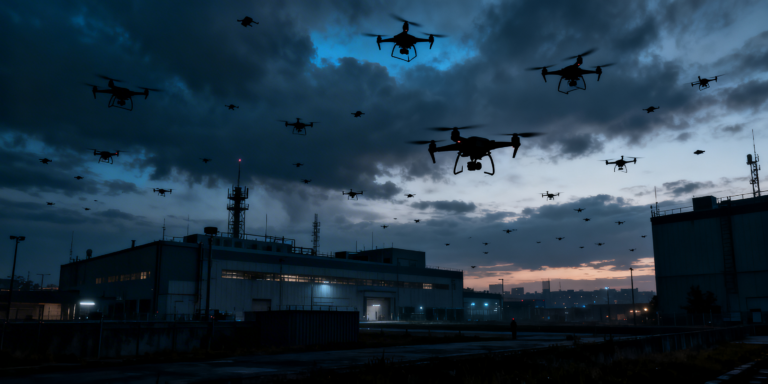
The Evolving Threat In recent years, the proliferation of cheap, highly capable commercial drones has transformed the security landscape. For critical infrastructure—such as power grids, oil refineries, and maritime ports—unmanned aerial systems (UAS) represent a severe asymmetric threat. From unauthorized surveillance to direct kinetic attacks, a single drone can cause catastrophic operational and financial damage.
The Flaw in Single-Sensor Solutions Historically, facilities relied on standalone RF scanners or basic radars. However, modern drones often operate autonomously, flying with radio silence or without GNSS reliance, rendering traditional jamming and RF detection obsolete. A standalone sensor simply creates blind spots.
The Multi-Layered Paradigm To achieve total airspace dominance, organizations must adopt a unified CUAS ecosystem. By fusing data from AESA pulse-Doppler radars, advanced RF sensors, and electro-optical (EO/IR) cameras, security teams gain a real-time, 4D air picture. This allows for seamless detection, AI-driven classification, and precise neutralization—ensuring zero blind spots in high-stakes environments. Proactive airspace management is no longer a luxury; it is an operational necessity.